

Slippery bathroom floors are one of the leading causes of home accidents worldwide. Whether it’s elderly family members, young children, or even yourself, one slip can lead to painful injuries and costly medical bills. This is especially common with smooth and glossy floor tiles. A floor that feels perfectly normal under dry conditions can become surprisingly slippery when wet.
If your existing toilet, kitchen or commercial floor is still in good condition but has become too slippery, anti-slip floor treatment can be a practical alternative to hacking out and replacing the tiles.
We provide professional anti-slip floor treatment for residential and commercial properties. The treatment can be carried out on most types of tiles and mineral-based floor surfaces, such as ceramic floor tiles, porcelain/homogeneous tiles, marble floor, and others. It can be applied on glossy finish tiles as well.
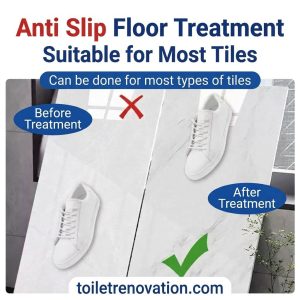
Our Professional Anti-Slip Floor Treatment is designed to make your bathroom/kitchen safer instantly – without the need for ugly floor mats or expensive renovation works.
The objective is simple: improve the grip of the existing floor while keeping the original appearance of the tiles as much as possible.
- Cost-Effective – No need to replace tiles or install expensive flooring
- Improves Slip Resistance – meets HDB’s Slip Resistance Specification SS485: 2011 & BCA’s Acceptable Slip Resistance Grading
- Safe For Use Even In Food Processing Areas – HACCP Certified
- Long Lasting – typically 24 months and above
- Peace of Mind – reduce accidents, protect your loved ones
What Is Anti-Slip Floor Treatment?
Anti-slip floor treatment is a chemical treatment that modifies the surface of the existing floor at a microscopic level.
Unlike an anti-slip mat or a conventional thick coating, the treatment is not simply a layer of paint or rubber placed over your tiles. The chemical reacts with the mineral surface and creates microscopic texture, channels or pores that greatly improve traction, particularly when the floor is wet.
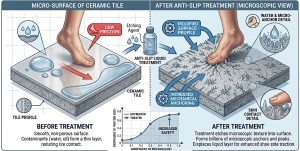
This gives your feet or footwear more grip against the floor surface. The effect is not ambiguous and is immediately noticeable.
The treatment is suitable for many commonly found mineral flooring materials, including:
- Ceramic tiles
- Porcelain tiles
- Homogeneous tiles
- Glazed tiles
- Many glossy or polished tiles
- Marble and other natural stone surfaces
- Concrete and other mineral-based surfaces
However, different tiles react differently to chemical treatment. This is why we do not simply use one chemical solution for every floor.
Can Anti-Slip Treatment Be Used on Glossy Tiles?
Yes. Anti-slip treatment can be applied to many types of glossy and smooth floor tiles.
Glossy tiles can be treated to improve their slip resistance, particularly when they become slippery when wet. However, because the treatment works by modifying the microscopic surface of the tile, some glossy surfaces may appear slightly less shiny or a little duller after treatment.
The extent of any change depends on the type of tile, its original finish, colour and surface characteristics.
We Test the Tile First
Before treating the entire floor, we always carry out a small test on an inconspicuous area.
This allows us to check how the particular tile reacts to the treatment and determine the most suitable application method. We assess both the improvement in slip resistance and any change in the appearance of the tile.
Depending on the tile, one application may be sufficient, while some surfaces may require two applications to achieve the desired level of slip resistance.
The test also allows you to see the actual result on your own tiles before we proceed with the full floor.
Our aim is not simply to maximise the roughness of the surface. We aim to achieve a good improvement in slip resistance while maintaining the original appearance of the tiles as much as possible.
Why Do We Use Different Chemicals for Different Tiles?
There is no single treatment solution that is ideal for every type of flooring.
A ceramic tile, porcelain tile, homogeneous tile, marble floor and concrete surface can have very different compositions and surface characteristics.
We therefore use a range of anti-slip treatment chemicals, selecting the formulation and treatment method according to the floor material.
For example, the approach used on a ceramic tile may not be the same as the approach used on porcelain, homogeneous tiles, marble or concrete.
A good anti-slip treatment is about finding the right balance between:
Slip resistance + appearance + durability
Increasing the chemical strength or treatment time indiscriminately is not necessarily better. An overly aggressive treatment can unnecessarily change the appearance of the tile.
How Does the Treatment Make the Floor Less Slippery?
Smooth floor tiles can have relatively little traction when water forms a layer between your foot and the tile surface.
During treatment, the chemical reacts with the mineral components of the flooring and modifies the surface at a microscopic level.
The resulting microscopic texture provides additional points of contact and improves traction.
You will generally not see large grooves or scratches on the floor. The changes are primarily at a microscopic level.
This is also why the treatment can be useful for floors that are difficult to replace simply because they are slippery.
Instead of hacking out perfectly usable tiles, we can treat the existing surface.
Where Can Anti-Slip Floor Treatment Be Used?
Our anti-slip treatment is suitable for a wide range of wet and high-traffic areas.
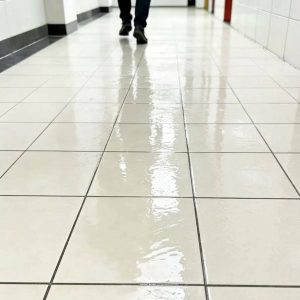
Residential Toilets & Bathrooms
This is one of the most common applications.
It is particularly useful for bathrooms where the floor regularly becomes wet from showering, bathing or washing.
It can be especially useful in homes occupied by elderly family members, young children or anyone who may have difficulty recovering from a slip.
Kitchen Floors
Kitchen floors can become slippery from water, oil, grease and food residue.
Anti-slip treatment can be considered where the existing kitchen tiles are smooth but the owner does not want to replace the flooring.
Restaurants & F&B Premises
Commercial kitchens, wash areas, toilet areas and other wet zones can experience frequent exposure to water, cleaning chemicals and grease.
A suitable anti-slip treatment can help improve floor traction without requiring major renovation works or prolonged closure of the premises.
Commercial & Industrial Areas
Depending on the floor material and site conditions, treatment can also be considered for:
- Restaurant wet areas
- Shop and commercial toilets
- Hotel bathrooms
- Service areas
- Walkways
- Common areas
- Concrete floors
- Other areas where improved slip resistance is required
Our Anti-Slip Floor Treatment Process
Based on photos sent by our customers, we would have determined the type of tile or flooring material that is being treated and decided on the appropriate solution.
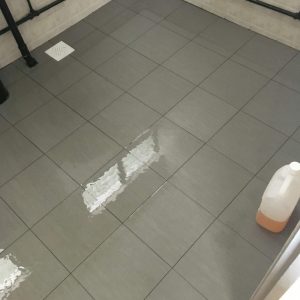
Step 1 – Test an Inconspicuous Area
We apply the selected treatment to a small area first.
We then assess both the anti-slip performance and appearance.
This is particularly important for glossy, dark-coloured, patterned or unfamiliar tiles.
Step 2 – Select the Appropriate Treatment
Based on the test, we determine the most suitable duration and application method.
Some floors require only one application.
Other surfaces may require two applications to achieve the best result.
The objective is to significantly increase the slip-resistance of the existing tiles with the least effect on the tile appearance, not to make it as rough as possible.
Step 3 – Treat the Entire Floor
Once the test result is satisfactory, the treatment is applied to the rest of the agreed area.
We take care to achieve an even treatment rather than concentrating only on visibly slippery sections.
Step 4 – Final Cleaning & Inspection
The floor is cleaned after treatment and checked before we leave.
The customer can then compare the treated surface with the original condition and experience the difference in grip.
Turnaround Time: 30-60 minutes per bathroom, and it can be used almost immediately after.
How Long Does Anti-Slip Treatment Last?
The actual lifespan depends on several factors, including:
- Type of tile
- Amount of foot traffic
- Frequency of cleaning
- Cleaning chemicals used
- Whether the floor is residential or commercial
- Amount of water, grease and contamination
- The original condition of the flooring
As a general guide, our anti-slip treatment typically lasts over 2 years or longer under normal conditions.
Residential toilet floors with relatively light traffic can naturally last longer than heavily used commercial areas.
Is Anti-Slip Treatment Better Than Replacing the Tiles?
It depends on the condition of your existing floor.
If your tiles are cracked, badly damaged, uneven or already due for renovation, replacing the flooring may make more sense.
But if the tiles are:
- Still in good condition
- Firmly installed
- Visually acceptable
- Difficult or expensive to replace
- Simply too slippery when wet
then anti-slip treatment can be a much simpler option.
You avoid the hacking, dust, noise, disposal and downtime associated with a full floor replacement.
This can be particularly useful when the owner wants to improve floor safety without turning a small problem into a major renovation project.
Does Anti-Slip Treatment Change the Appearance of the Tiles?
This is one of the most important questions to ask before carrying out any chemical anti-slip treatment.
The answer is: it can, depending on the tile.
Most applications are designed to minimise visible changes, but because the treatment modifies the surface, there can be some change in appearance.
In particular:
- Glossy tiles may appear slightly duller
- Very dark tiles may show some change in shade
- Highly polished surfaces may lose some of their original sheen
- Some patterned or textured tiles may look slightly different
This is why we conduct a test area first.
We would rather tell you honestly that a particular tile may change slightly in appearance than promise that every floor will remain completely unchanged.
Our aim is to find the best balance between appearance and anti-slip performance.
How Much Does Anti-Slip Floor Treatment Cost in Singapore?
Our indicative residential pricing is:
- Toilet Floor Tiles (HDB/Condo/Landed) – $150 Nett
- Kitchen Floor Tiles (HDB/Condo/Landed) – $350 Nett
- Other Areas / Commercial – Please contact us for a quote
Want an upfront estimate?
You can send us photos of your existing floor via WhatsApp.
For straightforward residential jobs, photographs are usually enough for us to provide an initial indication before arranging the actual treatment.
Looking for an Anti-Slip Floor Solution in Singapore?
If your toilet, kitchen, restaurant or commercial floor is slippery when wet, you may not need to replace the tiles.
Our professional anti-slip floor treatment is designed for ceramic, porcelain, homogeneous tiles, many glossy tiles, marble and concrete surfaces, with the appropriate treatment selected according to the flooring material.
Most importantly, we test first.
We want to achieve a meaningful improvement in slip resistance while keeping changes to the original appearance of your floor to a reasonable minimum.
Send us photographs of your existing floor for an initial assessment and indicative quotation.
We provide anti-slip floor treatment for HDB flats, condominiums, landed properties and commercial premises throughout Singapore.
Whatsapp Us For A Discussion & Quote!
Contact Us: 8777 5600 (Jack)
Contact Us: 8777 5600 (Jack)
 Send us a message on WhatsApp with photos of your existing bathroom/kitchen for an upfront quote.
 Once confirmed, we will arrange and schedule the date to go down to carry out the anti-slip floor treatment on the agreed date.
 On the scheduled work day, we will test on a small area first before proceeding with the entire toilet/kitchen.